
Seedbox Providers Keep Disappearing: How to Spot One Before It Takes Your Data With It
Provider shutdowns, not police action, are what actually costs seedbox users their data. Here is what the warning signs look like, and how to structure a setup that survives one.
While the headlines cover court orders and blocking laws, the thing that actually removes people's seedboxes is far more mundane: the provider stops trading. We removed SonicBit from our comparison this week after finding sonicbit.com listed for sale on a domain marketplace — the service is gone. It is not an isolated case. Seedgear shut down without notice, and this market has a long history of hosts that change plans and prices without contacting customers, or close accounts with no warning and no refund. Here is how to see it coming.
Compare only providers that are actually still trading
Every plan re-checked against the provider's own pricing page, with dead providers removed rather than left to rot in the table.
What happened to SonicBit
SonicBit was a mid-tier provider with plans around the $13–$20 mark, servers in the Netherlands and Germany, and a standard application set. When we re-checked every provider's pricing page on 1 August 2026, sonicbit.com no longer resolved to a seedbox service: it now shows a domain marketplace listing offering the name for sale at $11,095.
A domain listed for sale is about as unambiguous as an ending gets. There was no announcement we could find, which is itself the norm. We removed the provider from the comparison, deleted its plans, and redirected its old review and promo pages to the relevant hubs so nobody lands on a dead recommendation.
The warning signs, in the order they usually appear
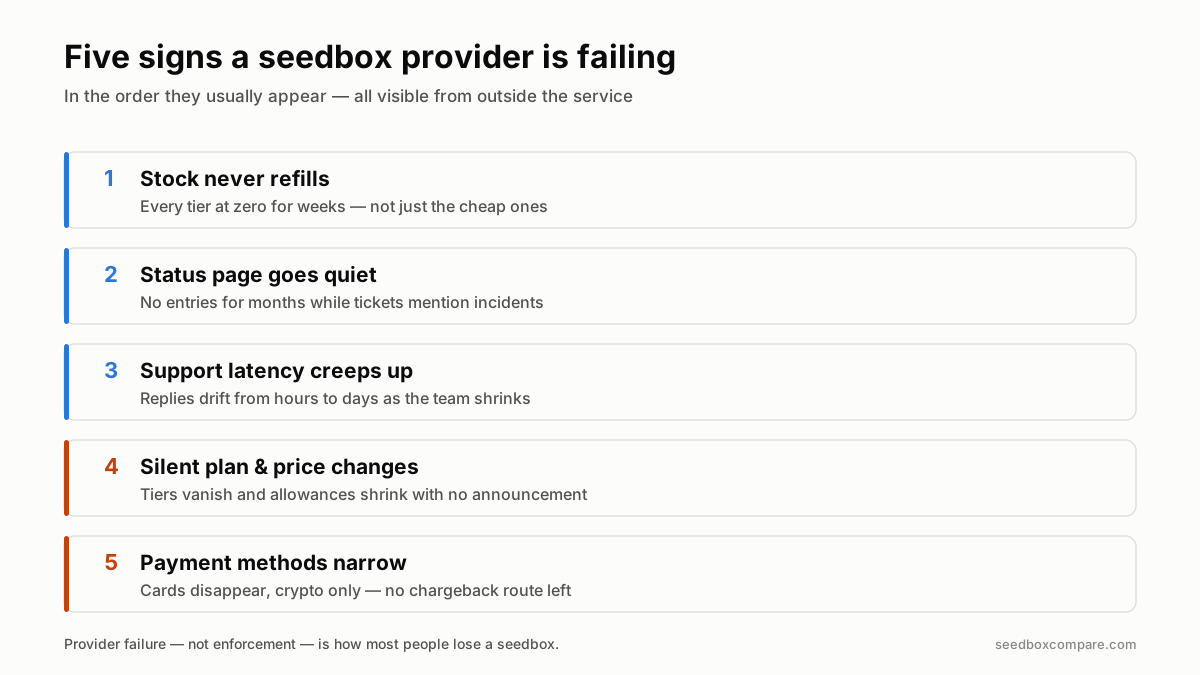
Providers rarely fail suddenly. They fail gradually, then all at once, and the early phase is visible from the outside if you know where to look.
1. Stock that never refills
Sold-out plans are normal in this market — capacity is genuinely constrained and the best-value tiers go quickly. What is not normal is every tier showing zero availability for weeks. A host that is not buying new capacity is either at the end of a hardware cycle or not investing any more.
Distinguishing the two is easy: check whether the sold-out tiers are only the cheap ones (healthy demand) or the whole range (a problem).
2. A status page that goes quiet
Most providers publish a status or announcements page. A page with no entries for months, while support tickets mention incidents, means the operational routine has broken down. Silence is a stronger signal than bad news.
3. Support latency creeping up
Response times are the first thing to degrade when a team shrinks. A host that answered within hours and now takes days has usually lost people. This is the signal most users notice first and dismiss most readily.
4. Plans and prices changing without an announcement
Quiet plan restructuring — tiers disappearing, allowances shrinking, prices moving without notice — indicates a host trying to fix unit economics. Sometimes that works. It is nonetheless the point at which you should stop prepaying.
5. Payment methods narrowing
When card processing disappears and only crypto remains, a payment provider has usually ended the relationship. Whatever the cause, it removes your chargeback route at exactly the moment you are most likely to need it.
How to structure a setup that survives a shutdown
You cannot predict which host will fail. You can make it cost you an afternoon rather than your library.
- Pay monthly. The discount on an annual plan is typically 15–20%. That is a poor trade against losing eleven prepaid months, and it is the single most common way people lose money in this market.
- Keep the only copy somewhere else. Treat the seedbox as a working disk, not as an archive. If losing it overnight would lose you data, the setup is wrong regardless of which provider you use.
- Know your export path before you need it. Confirm the host offers working FTP/SFTP or rclone access and roughly how long a full pull takes at your home connection speed. Discovering this during a shutdown is too late.
- Keep your configuration reproducible. Export your torrent client's session and *arr configurations periodically. Rebuilding on a new host is a short job if you have them and a long one if you do not.
- Check the provider before renewing, not just before buying. Availability, status page and support responsiveness take two minutes to verify and are worth re-checking every few months.
Which providers look structurally safer
Longevity and infrastructure ownership are the two attributes that correlate with surviving. Neither is a guarantee, and both are worth more than a marketing claim about uptime.
Track record
Whatbox has been serving customers since 2008, which in this market is exceptional. Feral Hosting and Ultra.cc (formerly UltraSeedbox) have likewise operated for many years under continuous ownership. A host that has survived several hardware cycles has demonstrated something no feature list can.
Who owns the hardware
Providers that own their servers and colocate them — Whatbox and Feral Hosting among those we track — carry less risk of an upstream supplier disappearing underneath them. Providers renting capacity can be perfectly reliable, but they inherit their supplier's problems as well as their own.
Billing and refund terms
Providers publishing a clear refund policy — Cloudboxes.io documents a 7-day policy, and several others offer trial periods — are making a commitment that a host planning to disappear generally avoids making.
How we keep this comparison current
This site earns commission when readers sign up through our links, which makes keeping dead providers listed actively harmful — to readers first, and to us second.
Our process: every provider's own pricing page is re-checked and prices are recorded in the currency the provider bills in, with the date of the check. Providers that stop trading are removed rather than left in place with stale data, and their old URLs are redirected instead of returning errors. The last full pass was 1 August 2026, which is when SonicBit came out and when Ultra.cc's entire plan range was rebuilt after it changed.
Frequently asked questions
Is SonicBit still operating?+
What happens to my data if a seedbox provider shuts down?+
How can I tell if a seedbox provider is about to close?+
Should I pay monthly or annually for a seedbox?+
Which seedbox providers have been around the longest?+
Ready to pick your seedbox?
Compare live prices, storage and upload allowances across every provider we track — then grab the current deal.