
Seedbox News: 2026 Blocking Rules Are Shifting From Websites to Hosting Infrastructure
Three decisions in a single month moved enforcement up the stack — from individual websites to the hosting providers and network operators underneath them.
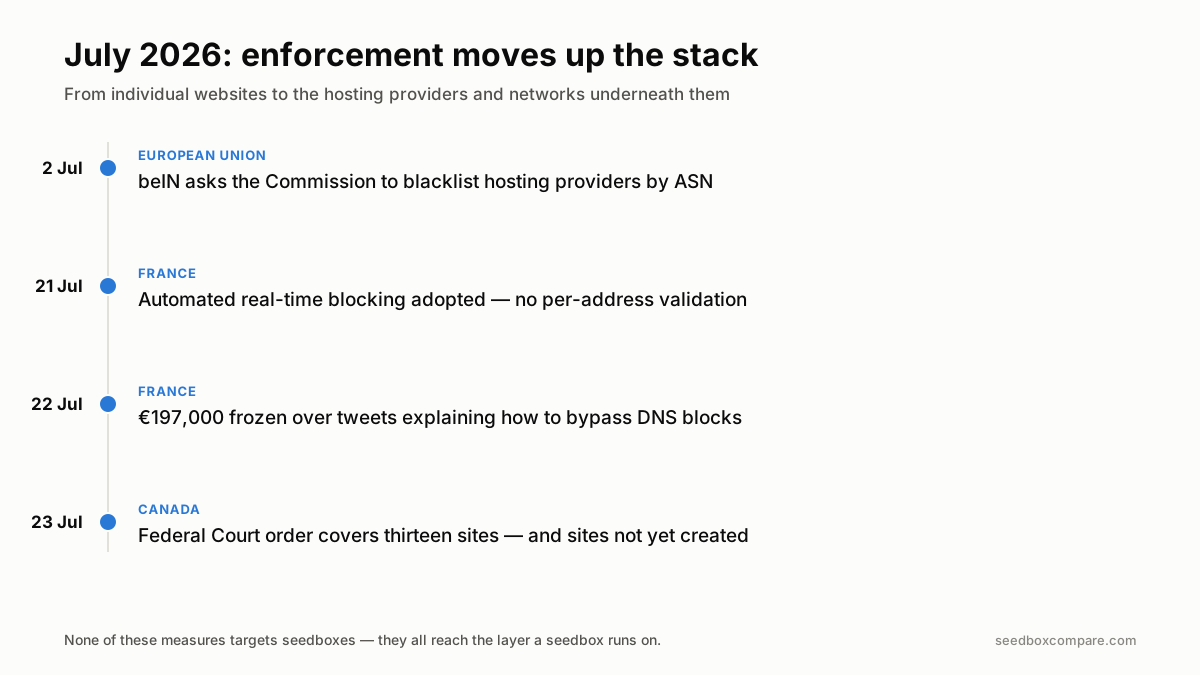
Copyright enforcement in 2026 has stopped aiming only at websites. Within roughly a week in late July, France adopted automated real-time blocking of live sports streams, a Canadian court issued a blocking order that covers sites which do not exist yet, and sports rightsholders formally asked the European Commission to let regulators blacklist entire hosting providers by their network identifiers. None of these measures targets seedboxes as such — but all three move the pressure point to the layer where a seedbox actually lives: the hosting provider and its network.
Compare providers by location, not just price
Server locations, storage, upload allowances and prices for every provider we track — checked against their live pricing pages.
What actually happened in July 2026
Three separate decisions, in three jurisdictions, pointing the same direction.
France: real-time blocking, without per-address validation
The French Parliament definitively adopted the bill on the organisation and financing of professional sport on 21 July 2026. It introduces an automated mechanism for blocking live sports streams, covering both streaming sites and IPTV services.
The substantive change is procedural: Arcom keeps oversight of the system, but its agents no longer have to validate each new address before it is cut off. Newly detected targets are pushed straight to ISPs, which must act without delay. The regulator had already rehearsed the approach during Roland-Garros and the football World Cup. A second change matters just as much — foreign rightsholders can now use the French blocking system, which was not previously possible.
Canada: an order that covers sites not yet created
On 23 July 2026, Canada's Federal Court issued a blocking order requiring ISPs to block thirteen pirate sites. What makes it notable is its 'expanded scope': the order is drafted to reach sites that do not exist yet, rather than requiring rightsholders to return to court for each new domain.
This is the logical endpoint of dynamic blocking. Once an order covers future targets, the list stops being a judicial decision and becomes an operational feed maintained between rightsholders and intermediaries.
The EU: blacklisting hosting providers by ASN
The most structurally significant item is a proposal, not yet law. As part of the European Commission's public consultation on the Copyright Directive review, beIN Sports proposed (published 2 July 2026) that the Commission establish a means for rights owners to report offshore non-compliant hosting providers, identified by their ASNs — the Autonomous System Numbers that identify a network operator and the IP ranges it announces.
The proposed assessment criteria are failure to comply with takedown requests, involvement in illegal content, non-compliance with legal obligations, and location outside the EU. European ICT providers — data centres, transit providers, internet exchanges and ISPs — would face a legal obligation to stop carrying traffic from designated ASNs and IP ranges.
The proposal is backed by the Audiovisual Anti-Piracy Alliance (AAPA), whose members include the Premier League, LaLiga, DAZN, Sky and Viaplay. beIN additionally asked for a 30-minute takedown window, real-time dynamic blocking orders, and stronger customer verification by infrastructure companies.
Why this matters even for entirely legitimate use
A seedbox is a rented server running standard software — torrent clients, Plex, Jellyfin, *arr tools, sync utilities. Plenty of people run one for uses nobody disputes: distributing Linux images, seeding open datasets, hosting a personal media library, keeping offsite backups.
The risk introduced by network-level measures is not legal, it is collateral. Blocking by ASN or IP range does not distinguish between customers of the same host. European ISPs made exactly this argument in the consultation, warning against IP-address blocking that could harm legitimate services and arguing that rightsholders should be held accountable for overblocking damage.
If that mechanism is ever adopted, the question stops being 'is what I do legal' and becomes 'does my provider share a network with someone who will get its ASN designated'.
- Shared IP ranges. Most seedbox plans are shared servers behind shared IP space. Action against a range affects every customer on it.
- Transit dependency. A provider blocked at transit or IXP level becomes unreachable from parts of Europe regardless of its own compliance record.
- No individual remedy. Designation would target a network operator, not a customer, so an affected user has no obvious route to contest it.
One more signal: circumvention advice is now being penalised
A separate French case from 22 July 2026 is worth noting because it targets speech about blocking rather than infringement itself. A French appeals court kept €197,000 of a former Uptobox employee's personal assets frozen, in a case brought in connection with Disney, over tweets explaining how to bypass ISP-level DNS blocks.
The direction of travel is consistent: the enforcement perimeter is widening from the infringing act, to the infrastructure that carries it, to publicly explaining how to route around it.
What this changes when choosing a provider
None of this makes renting a seedbox riskier in a legal sense for legitimate use. It does change which criteria deserve weight when comparing hosts.
Jurisdiction is a real specification, not a detail
Where the server physically sits determines which orders reach it. The Netherlands remains the dominant location in this market — Seedboxes.cc hosts exclusively there, and Whatbox, Ultra.cc and RapidSeedbox all offer Dutch locations alongside others. Providers with multiple regions (Ultra.cc runs Netherlands, Canada and Singapore; Whatbox runs Netherlands, United States and Singapore) give you somewhere to move if one location becomes awkward.
Infrastructure ownership tells you who answers a complaint
Providers differ sharply in how much of the stack they control. Whatbox and Feral Hosting own their hardware and colocate it; most others rent capacity from upstream providers. The more layers between you and the metal, the more parties can act on a complaint without anyone consulting your host.
Read the public-tracker policy before you pay
Most providers restrict or discourage public trackers precisely because that is where takedown notices originate. That policy is the single best indicator of how a host handles complaints — and of whether it is likely to end up on anyone's list.
Prefer providers with an exit
Monthly billing, clear data-export paths and more than one datacentre location are what let you move quickly. This is a good argument against annual prepayment at a provider you have not run for at least a month.
What to watch next
The EU consultation feeds into a legislative proposal on copyright expected to follow, so the ASN blacklist idea will either be dropped or turned into draft text over the coming period. Two things are worth tracking:
- Whether network-level designation survives into an actual legislative proposal, or is diluted into something closer to existing notice-and-action rules.
- Whether the French model — automated blocking with no per-address validation, open to foreign rightsholders — gets copied elsewhere in the EU. It is currently the most permissive implementation of dynamic blocking in Europe, and it now has a working precedent.
We will update this article as the consultation moves forward.
Frequently asked questions
Are seedboxes affected by the new blocking rules?+
Is renting a seedbox legal?+
What is ASN blocking and why does it matter?+
Which country is safest for a seedbox in 2026?+
Does a VPN protect against these measures?+
Ready to pick your seedbox?
Compare live prices, storage and upload allowances across every provider we track — then grab the current deal.